Workshop slides
Beyond Using AI
Revisit the Chicago workshop: AI in executive search, design thinking, and experiments that test business value.
41 pages · PDF · 2.1 MBRevisit the slides, plan an experiment, and explore where AI can create value in executive search.
Revisit the Chicago workshop: AI in executive search, design thinking, and experiments that test business value.
41 pages · PDF · 2.1 MB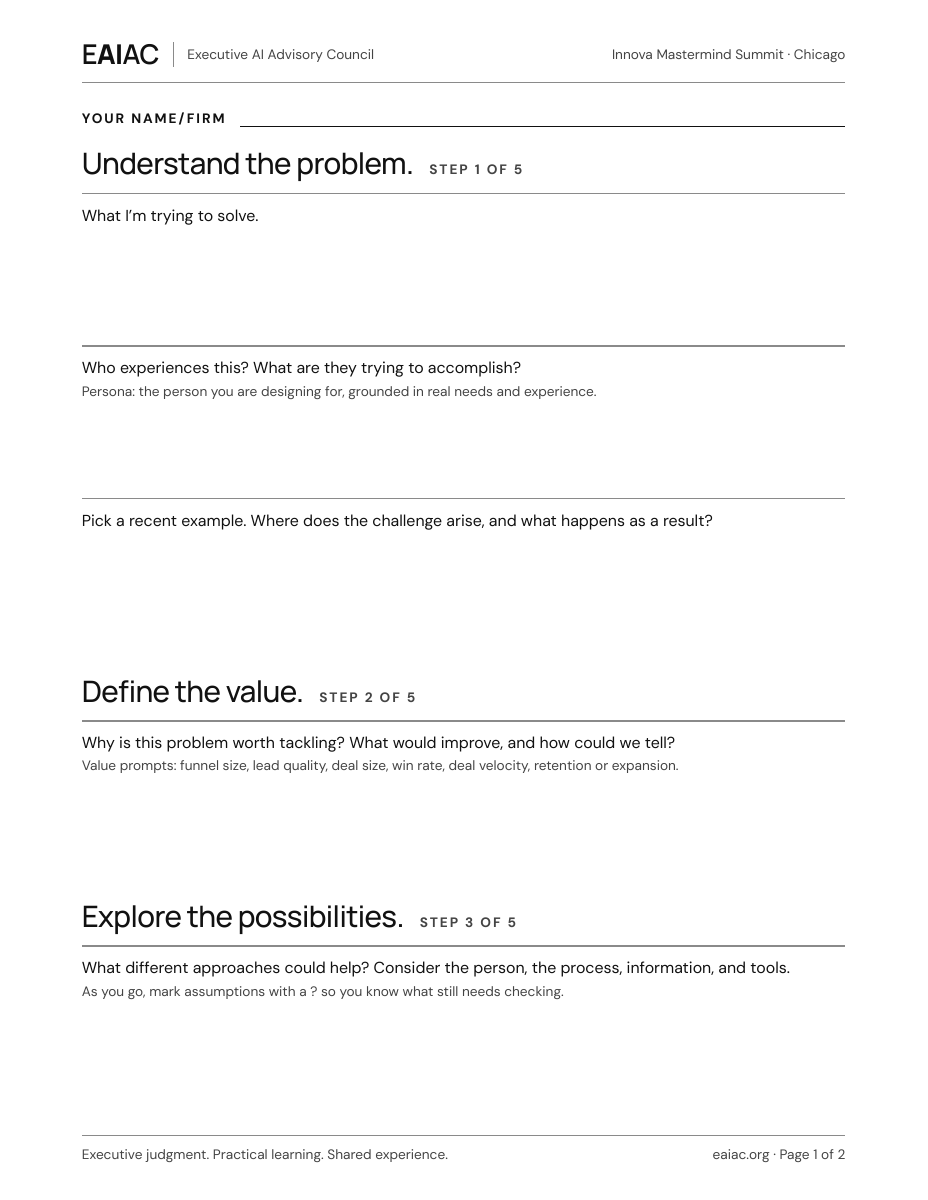
Define the problem, choose a measure of success, and plan what to build and test.
2 pages · PDF · 25 KB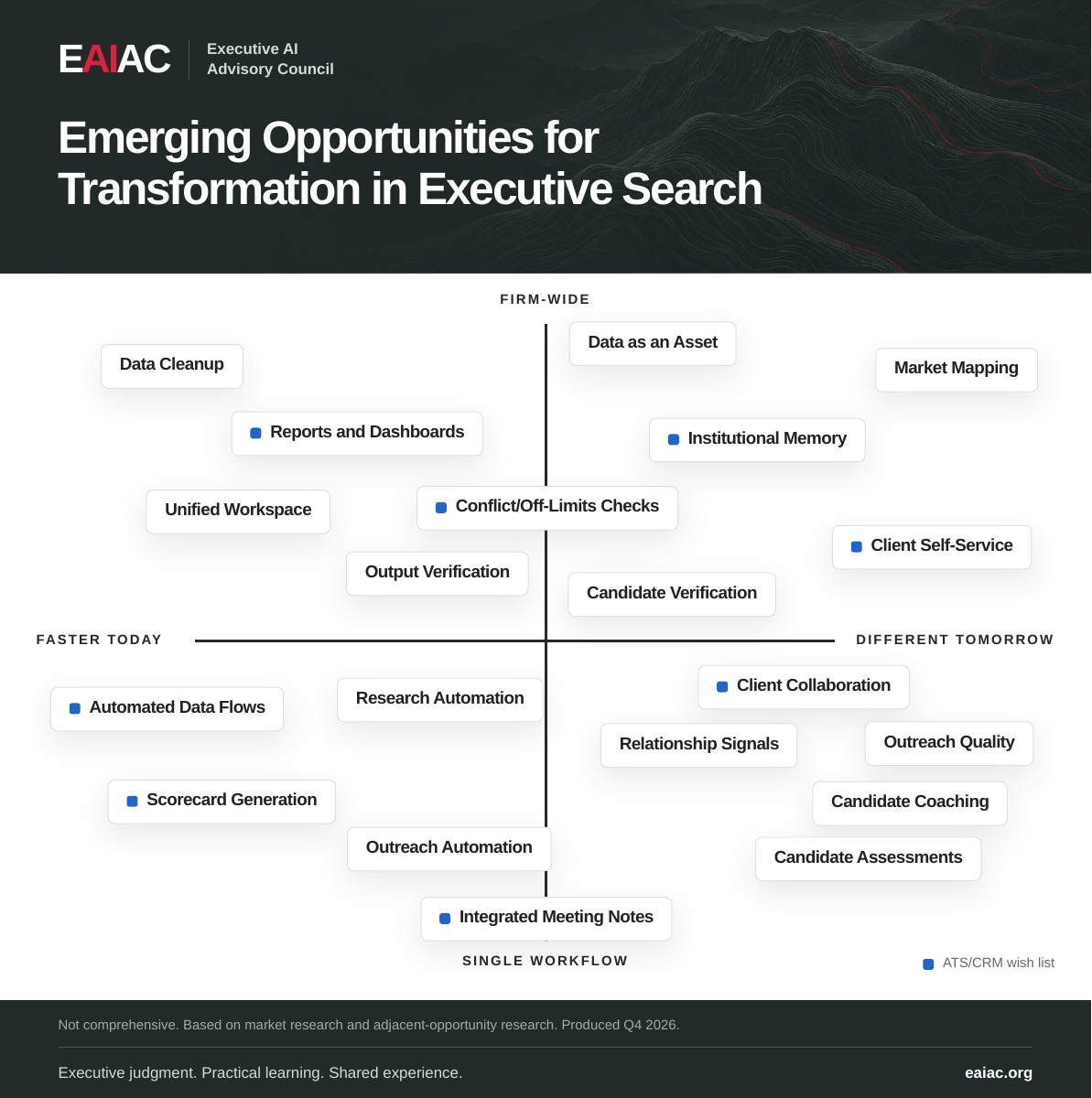
Explore where AI could improve a workflow or change how your firm works.
1 page · PDF · 1.6 MB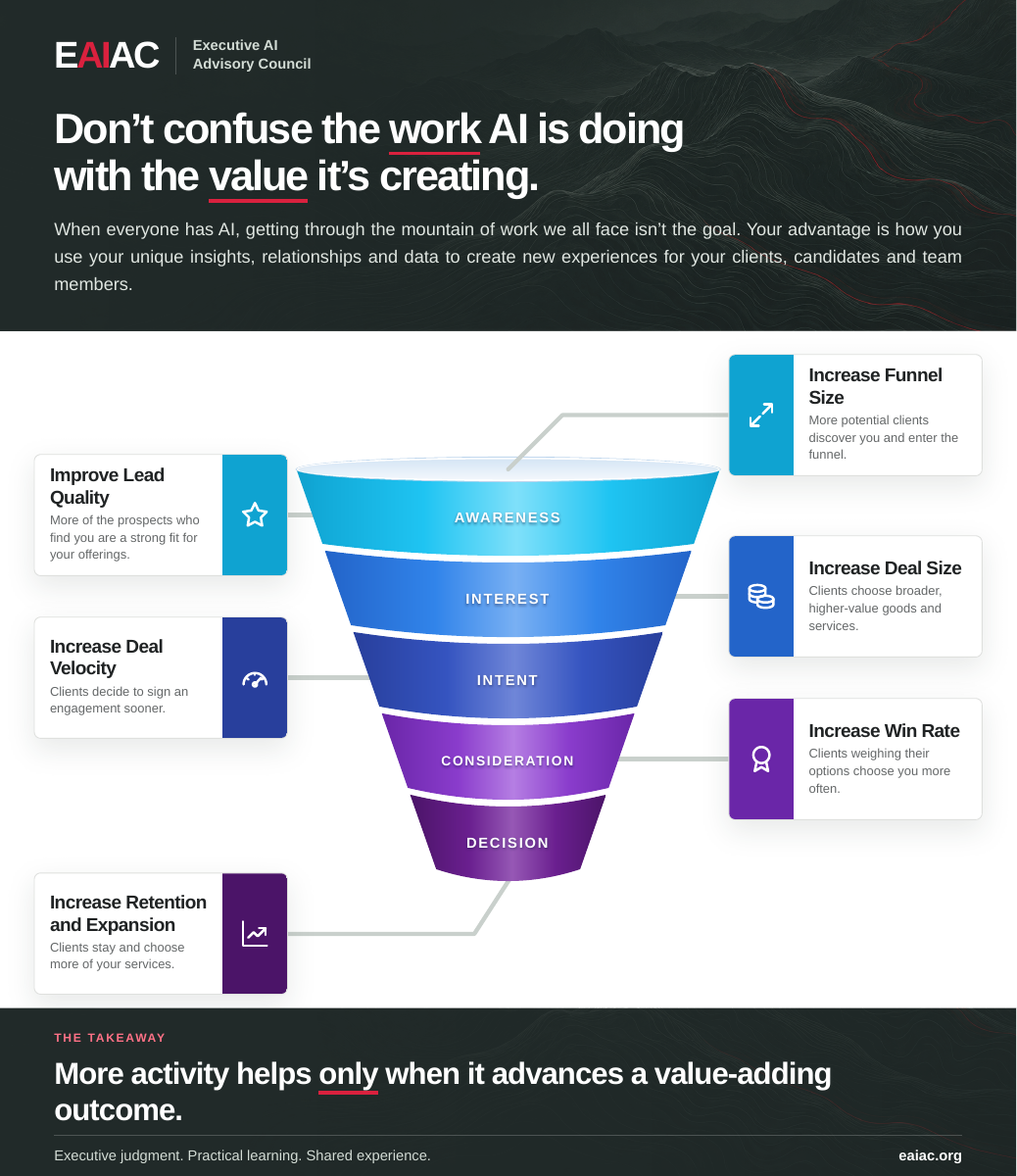
Connect AI activity to outcomes: lead quality, deal size, speed, win rate, and more.
1 page · PDF · 2.8 MB
See how search firms are changing their work, using evidence, and developing services.
8 pages · PDF · 774 KBSynthetic examples, working files, and starter bundles for hands-on exploration.
 First Time Vibe Coding?No coding experience needed. We’ll walk you through your first prototype.Start Here
Each ZIP includes CSV and JSON data, fictional source documents, a data dictionary, and a START-HERE.html guide. Download, unzip, and open the guide to begin.
13 datasets
Turn an intake into a usable brief or scorecard.
Try: Scorecard Generation, Client Collaboration. More ideas
From the starter pack · fictional data
Included tables: careers.csv, documents.csv, interactions.csv, offers.csv, organizations.csv, participations.csv, people.csv, searches.csv, stage_events.csv, tasks.csv, users.csv.
| search_id | client_id | role | owner_id |
|---|---|---|---|
| S01 | O01 | CFO succession | U01 |
| S02 | O02 | Portfolio-company CEO | U02 |
| S03 | O03 | Transformation leader | U01 |
All fields in this table: search_id, client_id, role, owner_id, status, opened_at, closed_at, currency, fee_amount, confidentiality.
Source document excerpt · documents/brief.txt
FICTIONAL WORKSHOP MATERIAL — INNOVA
Approved search brief
Document: D-brief | Search: S01
Observed: 2026-10-15 | Visibility: client_shared

S01 | CFO succession at Alder Quay Systems (O01). Sponsor: board member U05. The incumbent is not aware; external outreach must describe an unnamed business-services group. First-year outcomes: build a 13-week cash forecast, improve lender reporting, and prepare finance for two acquisitions. Location and compensation are not approved. CEO favors transferable operating experience; board favors listed-company exposure. Do not disclose the succession rationale in candidate outreach.
Explore careers, companies and evidence for a target list.
Try: Market Mapping, Research Automation, Candidate Verification. More ideas
From the starter pack · fictional data
Included tables: careers.csv, claims.csv, documents.csv, interactions.csv, offers.csv, organizations.csv, participations.csv, people.csv, searches.csv, stage_events.csv, tasks.csv, users.csv.
| person_id | name | current_organization_id | |
|---|---|---|---|
| P001 | Alex Morgan | alex.morgan@example.invalid | O04 |
| P002 | Blair Chen | blair.chen@example.invalid | O05 |
| P003 | Casey Patel | casey.patel@example.invalid | O05 |
All fields in this table: person_id, name, email, current_organization_id, title, location, availability, relocation, contact_preference, relationship_owner_id, observed_at, verification_status, synthetic.
Source document excerpt · documents/brief.txt
FICTIONAL WORKSHOP MATERIAL — INNOVA
Approved search brief
Document: D-brief | Search: S01
Observed: 2026-10-15 | Visibility: client_shared

S01 | CFO succession at Alder Quay Systems (O01). Sponsor: board member U05. The incumbent is not aware; external outreach must describe an unnamed business-services group. First-year outcomes: build a 13-week cash forecast, improve lender reporting, and prepare finance for two acquisitions. Location and compensation are not approved. CEO favors transferable operating experience; board favors listed-company exposure. Do not disclose the succession rationale in candidate outreach.
Draft relevant outreach and coordinate the next conversation.
Try: Outreach Automation, Outreach Quality, Relationship Signals. More ideas
From the starter pack · fictional data
Included tables: careers.csv, claims.csv, documents.csv, interactions.csv, offers.csv, organizations.csv, participations.csv, people.csv, searches.csv, stage_events.csv, tasks.csv, users.csv.
| interaction_id | person_id | search_id | owner_id |
|---|---|---|---|
| I0001 | P001 | S01 | U01 |
| I0002 | P002 | S01 | U01 |
| I0003 | P003 | S01 | U01 |
All fields in this table: interaction_id, person_id, search_id, owner_id, kind, occurred_at, summary, visibility.
Source document excerpt · documents/brief.txt
FICTIONAL WORKSHOP MATERIAL — INNOVA
Approved search brief
Document: D-brief | Search: S01
Observed: 2026-10-15 | Visibility: client_shared

S01 | CFO succession at Alder Quay Systems (O01). Sponsor: board member U05. The incumbent is not aware; external outreach must describe an unnamed business-services group. First-year outcomes: build a 13-week cash forecast, improve lender reporting, and prepare finance for two acquisitions. Location and compensation are not approved. CEO favors transferable operating experience; board favors listed-company exposure. Do not disclose the succession rationale in candidate outreach.
Compare claims, interviews and references with transparency where there is uncertainty.
Try: Candidate Assessments, Candidate Coaching, Output Verification. More ideas
From the starter pack · fictional data
Included tables: careers.csv, claims.csv, documents.csv, interactions.csv, offers.csv, organizations.csv, participations.csv, people.csv, searches.csv, stage_events.csv, tasks.csv, users.csv.
| claim_id | person_id | field | value |
|---|---|---|---|
| CL01 | P001 | forecast_error_reduction | approximately 30 percent |
| CL03 | P001 | relocation | might consider London; not discussed with family |
All fields in this table: claim_id, person_id, field, value, source_document_id, observed_at, verification_status, visibility.
Source document excerpt · documents/brief.txt
FICTIONAL WORKSHOP MATERIAL — INNOVA
Approved search brief
Document: D-brief | Search: S01
Observed: 2026-10-15 | Visibility: client_shared

S01 | CFO succession at Alder Quay Systems (O01). Sponsor: board member U05. The incumbent is not aware; external outreach must describe an unnamed business-services group. First-year outcomes: build a 13-week cash forecast, improve lender reporting, and prepare finance for two acquisitions. Location and compensation are not approved. CEO favors transferable operating experience; board favors listed-company exposure. Do not disclose the succession rationale in candidate outreach.
Turn discussions, feedback and history into usable next actions.
Try: Integrated Meeting Notes, Client Self-Service, Institutional Memory, Unified Workspace. More ideas
From the starter pack · fictional data
Included tables: careers.csv, documents.csv, interactions.csv, offers.csv, organizations.csv, participations.csv, people.csv, searches.csv, stage_events.csv, tasks.csv, users.csv.
| task_id | search_id | owner_id | description |
|---|---|---|---|
| T01 | S01 | U02 | Compare London travel and office costs |
| T02 | S01 | U01 | Confirm compensation approval |
All fields in this table: task_id, search_id, owner_id, description, due_date, status.
Source document excerpt · documents/brief.txt
FICTIONAL WORKSHOP MATERIAL — INNOVA
Approved search brief
Document: D-brief | Search: S01
Observed: 2026-10-15 | Visibility: client_shared

S01 | CFO succession at Alder Quay Systems (O01). Sponsor: board member U05. The incumbent is not aware; external outreach must describe an unnamed business-services group. First-year outcomes: build a 13-week cash forecast, improve lender reporting, and prepare finance for two acquisitions. Location and compensation are not approved. CEO favors transferable operating experience; board favors listed-company exposure. Do not disclose the succession rationale in candidate outreach.
Reconcile records, inspect delivery metrics and test workflow rules.
Try: Data Cleanup, Reports and Dashboards, Automated Data Flows, Data as an Asset, Conflict/Off-Limits Checks. More ideas
From the starter pack · fictional data
Included tables: careers.csv, dirty_crm.csv, documents.csv, interactions.csv, offers.csv, organizations.csv, participations.csv, people.csv, searches.csv, stage_events.csv, tasks.csv, users.csv.
| source_record_id | name | organization_id | |
|---|---|---|---|
| CRM-A001 | Alex Morgan | alex.morgan@example.invalid | O03 |
| CRM-B077 | A. Morgan | alex.morgan@example.invalid | O04 |
| CRM-B078 | Alex Morgan | alex.morgan.11@example.invalid | O02 |
All fields in this table: source_record_id, name, email, organization_id, observed_at, search_id.
Eight complete dossiers with interviews, references, coaching tasks and a shared evidence rubric.
Try: Candidate Assessments, Candidate Coaching, Output Verification, Candidate Verification. More ideas
Fictional sample records
| question_id | person_id | question | observable_success |
|---|---|---|---|
| CQ01 | P001 | The lender asks why the forecast changed again. Explain the uncertainty without hiding it. | Explain your contribution without claiming the controller’s work or presenting the approximate improvement as verified. |
| CQ02 | P002 | Explain why a division-level result is relevant without claiming group-level scope. | Translate divisional experience honestly and ask what support the group CFO role would provide. |
| CQ03 | P003 | The interviewer asks whether you personally negotiated the acquisition. Give an accurate answer and bridge to your relevant experience. | Use the integration example. Say directly where your experience ends and do not invent a deal-negotiation story. |
Source document excerpt
FICTIONAL WORKSHOP SOURCE
Alex Morgan career statement
XL-P001-BIO | candidate_private | 2026-10-30 | S01

Alex Morgan, CFO at O04. Directory location: London; relocation not established.
Relevant professional scope: Group treasury and lender reporting across four units. Team size: 24. Historical experience includes industrial distribution in a private setting; this does not reclassify the current employer.
Candidate-reported outcome: Forecast error may have fallen about 30%; baseline not verified.
Career dates and employers are in common/careers.csv. Contact is the non-deliverable address in common/people.csv. This biography is a source claim, not independent confirmation.
Sixty evidence-linked profiles, saved filter scenarios, reference connections and fictional flight routes.
Try: Market Mapping, Client Collaboration, Research Automation. More ideas
Fictional sample records
| achievement_id | person_id | source_document_id | metric |
|---|---|---|---|
| ACH001 | P001 | CAL-P001 | forecast_error_relative_reduction |
| ACH002 | P002 | CAL-P002 | reporting_preparation |
| ACH003 | P003 | CAL-P003 | units_integrated |
Source document excerpt
FICTIONAL WORKSHOP SOURCE
Alex Morgan calibration evidence
CAL-P001 | internal | 2026-10-30 | S01

Executive: P001, Alex Morgan. Current employer and title remain those in common/people.csv.
Historical end market: industrial distribution.
Prior listed-company experience: False. Group-level finance ownership: True. Cash forecasting ownership evidenced: True. Post-close integration ownership evidenced: not supplied.
Authored dossier context: I chaired the weekly risk review and asked the controller to rebuild the forecast with operations. I did not build the model myself. The weekly discussion improved. I would check the historical reports before quoting the 30 percent number.
An absent value means unknown, not no experience. No field establishes candidate interest, eligibility or future performance.
Thirty dated signals, relationship links, contact history and eight calendar events.
Try: Relationship Signals, Outreach Quality, Outreach Automation. More ideas
Fictional sample records
| calendar_event_id | person_id | search_id | meeting_type |
|---|---|---|---|
| CALX01 | P001 | S01 | candidate |
| CALX02 | P002 | S01 | candidate |
| CALX03 | P003 | S01 | candidate |
Source document excerpt
FICTIONAL WORKSHOP SOURCE
Signal excerpt 1
SIG001 | internal | 2026-10-20 | S01

Fictional source excerpt. Subject name: Alex Morgan; proposed identity P001.
Event type: promotion. Event date: 2026-10-20. Observed date: 2026-10-20. Originating story: NEWS001. Source status: current.
Professional congratulations may be relevant; does not imply job interest.
Do not treat the observation as a candidate statement of interest.
Ten substantial transcripts with version history, access context and reusable search questions.
Try: Integrated Meeting Notes, Institutional Memory, Scorecard Generation, Unified Workspace, Client Self-Service. More ideas
Fictional sample records
| version_id | search_id | effective_at | location |
|---|---|---|---|
| BV01 | S01 | 2026-08-15 | Chicago office-based preference |
| BV02 | S01 | 2026-10-16 | not approved |
| BV03 | S01 | 2026-10-26 | London and hybrid considered |
Source document excerpt
FICTIONAL WORKSHOP SOURCE
Standardized role scorecard template
MT-SCORECARD-TEMPLATE | internal | 2026-10-30 | S01

Role and search ID; first-year business outcome; observable criterion; evidence needed; required or preferred or unresolved; decision owner; source quote and date; version and approval state. Do not invent weights. A draft is not approved merely because it is complete.
Three branching business exercises with role briefs, timed injects and synthetic participant traces.
Try: Candidate Assessments, Candidate Coaching. More ideas
Fictional sample records
| competency_id | name | anchor_1 | anchor_3 |
|---|---|---|---|
| cash_forecasting | Cash forecasting | Explains no owned process | Owns recurring forecast with finance and operations |
| lender_communication | Lender communication | No direct lender responsibility shown | Owns recurring lender reporting and explains variances |
| integration | Acquisition integration | No owned integration work shown | Owns a post-close workstream and explains adoption |
Source document excerpt
FICTIONAL WORKSHOP SOURCE
How to run a text simulation
SIM-RUNNER | internal | 2026-10-30 | S01

Choose one simulation and show only its brief and current inject. Give the participant three minutes to choose or propose an alternative and explain why. Reveal that choice’s immediate consequence; move to the next node. Record exact reasoning, not just A/B/C. Never send all future injects to a role-player before starting. A prototype may load the branch table, but should hide unreached branches. Practice traces are invented examples, not observed human behavior. Review missing evidence, tradeoffs, decision ownership and willingness to correct. Keep facilitator expectations out of the model performing the participant role.
Three fictional service packages, six client requests, effort assumptions and scenario costs.
Try: Client Self-Service, Client Collaboration, Reports and Dashboards. More ideas
Fictional sample records
| request_id | client_id | requested_outcome | budget_usd |
|---|---|---|---|
| RQ01 | O01 | Research names without contacting candidates | 15000 |
| RQ02 | O02 | Five executives guaranteed to accept | 30000 |
| RQ03 | O03 | Engaged pipeline with weekly visibility | 28000 |
Source document excerpt
FICTIONAL WORKSHOP SOURCE
Fictional economics and scope definitions
EC-DEFINITIONS | internal | 2026-10-30 | S01

All figures are invented workshop assumptions in USD, not pricing advice or market benchmarks. Revision hours are consultant hours. Baseline labor = research_hours*65 + (consultant_hours+revision_hours)*150 + coordination_hours*45. Scenario labor = baseline labor*effort_multiplier + additional_consultant_hours*150. Total modeled cost = scenario labor*(1+allocated_overhead_fraction) + direct_expense_usd. Net revenue = price_usd*(1-discount_fraction). Modeled contribution = net revenue - total modeled cost; contribution margin = contribution/net revenue. Taxes, financing, replacement guarantees and acquisition costs are excluded, so this is not accounting profit. Deadlines in requests are wishes, not accepted commitments.
Shared competency definitions, role criteria, development plans and fictional compensation observations.
Try: Candidate Assessments, Candidate Coaching, Reports and Dashboards, Data as an Asset. More ideas
Fictional sample records
| observation_id | role | scope | country |
|---|---|---|---|
| PAY001 | CFO | group | UK |
| PAY002 | CFO | division | CA |
| PAY003 | CFO | group | DE |
Source document excerpt
FICTIONAL WORKSHOP SOURCE
Development and assessment boundary
DEV-BOUNDARIES | internal | 2026-10-30 | S01

These plans are candidate-private exercises, not client suitability judgments. A better practice answer does not prove better on-the-job results. Keep observations separate from goals and from confirmed outcomes. Do not mark a plan complete because its review date arrives. The competency model is invented for this workshop and does not reproduce any vendor’s proprietary intellectual property.
No datasets match both filters. Try another role or work area, or clear the filters.
Ideas for How to Use This Data ↗All people, organizations, and scenarios are fictional. CSV and JSON files are alternative formats of the same records. For a data-cleanup exercise, start with the dirty CRM before consulting clean records.
Reach out for details at contact@eaiac.org.

Pick an idea below, or bring your own. Build one small experiment in a simulated work environment.
Workflow: Select one candidate file, read the biography, interview, and reference, then generate and edit a summary with links to those documents.
Expected outcome: A summary whose conclusions can be checked against the documents, with missing or contradictory information clearly identified.
Workflow: Select a candidate, compare their recorded experience with the skill definitions, and choose coaching questions for areas needing more detail or practice.
Expected outcome: A coaching agenda with a reason for each question and a clear description of what a stronger answer would demonstrate.
Use the supplied fictional records. Simulate any email, calendar or ATS actions. Decide what you want to learn before testing.
Open Printable Page ↗Pick an idea below, or bring your own. Build one small experiment in a simulated work environment.
Workflow: Apply search criteria to the profiles, inspect the matching records, then change a filter and compare the results.
Expected outcome: A list that explains why each profile matches and separates missing information from a confirmed mismatch.
Workflow: Choose a search scenario and review profiles together. Adjust one requirement at a time and see which profiles enter or leave the list.
Expected outcome: A revised set of search criteria and a record of which changes expanded or narrowed the pool.
Use the supplied fictional records. Simulate any email, calendar or ATS actions. Decide what you want to learn before testing.
Open Printable Page ↗Pick an idea below, or bring your own. Build one small experiment in a simulated work environment.
Workflow: Review recent news and contact updates. Check the person and date, remove duplicate or outdated items, and select a reason for a follow-up.
Expected outcome: A short list of timely reasons to contact someone, each linked to its source.
Workflow: Select a calendar event and bring together the available contact history, notes, and attachments. Try an event with a missing attachment.
Expected outcome: A meeting brief showing who is attending, what to discuss, and which documents still need to be obtained.
Use the supplied fictional records. Simulate any email, calendar or ATS actions. Decide what you want to learn before testing.
Open Printable Page ↗Pick an idea below, or bring your own. Build one small experiment in a simulated work environment.
Workflow: Choose a meeting transcript and generate a task list. Check each task against the transcript, record who will do it and any agreed deadline, and mark suggestions that were not agreed.
Expected outcome: A task list with a responsible person and deadline where the meeting provides them. Unassigned tasks and undecided suggestions remain clearly marked.
Workflow: Type a question about a search or client. Review answers from meeting transcripts and open the original passages. Check the date and who the information can be shared with.
Expected outcome: An answer with a source you can verify, plus a clear indication when the records do not answer the question or cannot be shared with the intended reader.
Use the supplied fictional records. Simulate any email, calendar or ATS actions. Decide what you want to learn before testing.
Open Printable Page ↗Pick an idea below, or bring your own. Build one small experiment in a simulated work environment.
Workflow: Choose a case, read the situation, and record a decision and your reason. Continue through the next stages as new information appears.
Expected outcome: A record of the decisions, reasons, and information available at each stage that you can review after the exercise.
Workflow: Complete a case, reset it, and make a different decision. Compare what happened in each simulated attempt.
Expected outcome: A side-by-side comparison of the choices and simulated results, with any invented consequences clearly labeled.
Use the supplied fictional records. Simulate any email, calendar or ATS actions. Decide what you want to learn before testing.
Open Printable Page ↗Pick an idea below, or bring your own. Build one small experiment in a simulated work environment.
Workflow: Choose a client request, compare the available service packages, and select one. Flag any requested work the package does not include.
Expected outcome: A proposed package with included work, exclusions, and questions to resolve before agreeing to the work.
Workflow: Select a package, review the supplied hours and costs, and change an assumption such as time spent on research. Compare the estimate with the package price.
Expected outcome: A cost and margin estimate with visible calculations that shows which assumptions have the largest effect.
Use the supplied fictional records. Simulate any email, calendar or ATS actions. Decide what you want to learn before testing.
Open Printable Page ↗Pick an idea below, or bring your own. Build one small experiment in a simulated work environment.
Workflow: Select a person, review the recorded skill assessments, and choose an area to practice. Add an activity and a way to check progress.
Expected outcome: A development plan connecting each activity to a specific skill and an observable result to look for at the next review.
Workflow: Filter the fictional pay records by role, company size, and date. Review the matching records and compare the amounts.
Expected outcome: A summary showing the selected records, sample size, and differences. It should describe this fictional sample without claiming to establish market pay.
Use the supplied fictional records. Simulate any email, calendar or ATS actions. Decide what you want to learn before testing.
Open Printable Page ↗Pick an idea below, or bring your own. Build one small experiment in a simulated work environment.
Workflow: Select a search and review the client intake notes. Generate a brief, edit the requirements, and list questions to send back to the client.
Expected outcome: A usable brief that separates confirmed requirements from unanswered questions and links each requirement to the notes.
Workflow: Select a search and compare requirements from different stakeholders. Open the source for each difference and record what needs clarification.
Expected outcome: A list of conflicting requirements and specific questions the client needs to resolve.
Use the supplied fictional records. Simulate any email, calendar or ATS actions. Decide what you want to learn before testing.
Open Printable Page ↗Pick an idea below, or bring your own. Build one small experiment in a simulated work environment.
Workflow: Select a person, review their career and company history, and open the documents supporting each claim.
Expected outcome: A short research summary showing what is supported by the records and what still needs checking.
Workflow: Choose search criteria, filter the directory, and review why each person appears. Change one criterion and compare the lists.
Expected outcome: A target list with a clear reason for each inclusion and missing information marked for follow-up.
Use the supplied fictional records. Simulate any email, calendar or ATS actions. Decide what you want to learn before testing.
Open Printable Page ↗Pick an idea below, or bring your own. Build one small experiment in a simulated work environment.
Workflow: Select a contact, review the last conversation and any outstanding commitments, and prepare talking points for the next call.
Expected outcome: A short call brief showing the last interaction, what was promised, and what to discuss next.
Workflow: Select a contact and a reason to follow up. Generate a draft from the contact history, edit it, and use a simulated send button.
Expected outcome: A relevant message that uses only recorded facts, with the draft and simulated send recorded in the contact history.
Use the supplied fictional records. Simulate any email, calendar or ATS actions. Decide what you want to learn before testing.
Open Printable Page ↗Pick an idea below, or bring your own. Build one small experiment in a simulated work environment.
Workflow: Select a candidate and compare their claims with interview notes and references. Open the source for each claim and flag disagreements or missing evidence.
Expected outcome: A review list showing supported claims, conflicting accounts, and questions that need follow-up.
Workflow: Select a candidate, review gaps in their records, and generate questions to address those gaps. Edit and choose the questions for an interview.
Expected outcome: An interview plan where each question explains what information it is intended to establish.
Use the supplied fictional records. Simulate any email, calendar or ATS actions. Decide what you want to learn before testing.
Open Printable Page ↗Pick an idea below, or bring your own. Build one small experiment in a simulated work environment.
Workflow: Select a search and collect its latest notes, open tasks, and unresolved decisions. Review who is responsible for each task and add missing assignments.
Expected outcome: A handover that tells the next recruiter what to do, who is responsible, and which decisions still need agreement.
Workflow: Select a search and generate a progress update from its notes and tasks. Review and edit the client version before a simulated send.
Expected outcome: An accurate update with next steps that leaves out information marked for internal use only.
Use the supplied fictional records. Simulate any email, calendar or ATS actions. Decide what you want to learn before testing.
Open Printable Page ↗Pick an idea below, or bring your own. Build one small experiment in a simulated work environment.
Workflow: Load dirty_crm.csv, review possible duplicates side by side, and choose whether to merge them or keep them separate. Try undoing a change.
Expected outcome: A review queue that explains each suggested match and preserves the original records so changes can be reversed.
Workflow: Select a search, view its stages and tasks, and open the details for overdue or stalled work.
Expected outcome: A progress view that shows where work is waiting and the task or event records behind each status.
Use the supplied fictional records. Simulate any email, calendar or ATS actions. Decide what you want to learn before testing.
Open Printable Page ↗Pick an idea below, or bring your own. Build one small experiment in a simulated work environment.
Workflow: Select a search, review its brief, research a candidate, draft outreach, and create a follow-up task in one simulated workspace.
Expected outcome: The same search and candidate details carry through each step, with drafts and task updates saved in the prototype.
Workflow: Open a search as a recruiter and update its progress. Switch to the client view and review the update and available next actions.
Expected outcome: Both views show consistent progress while internal notes remain visible only in the recruiter view.
Use the supplied fictional records. Simulate any email, calendar or ATS actions. Decide what you want to learn before testing.
Open Printable Page ↗